
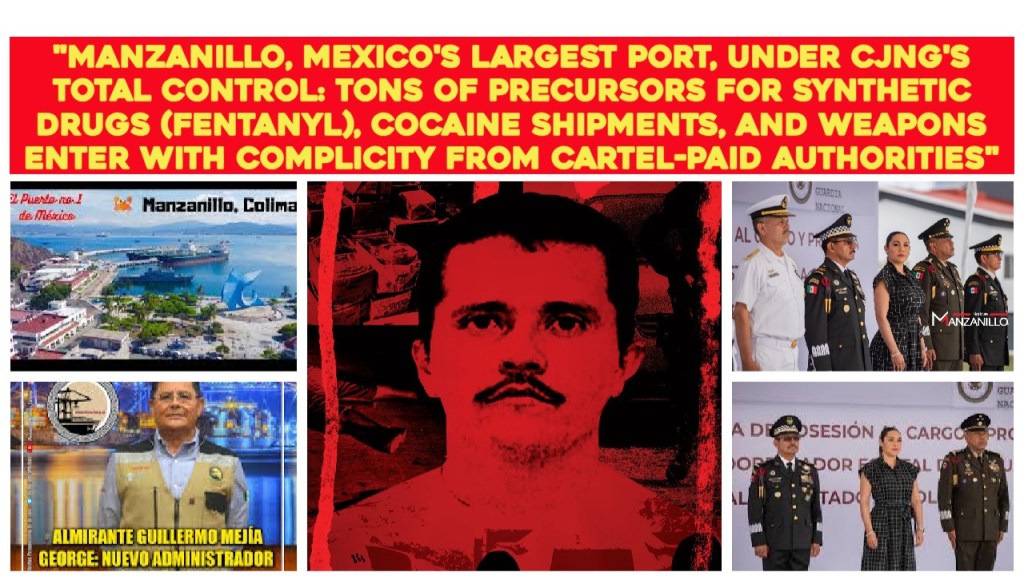
«The Port of Manzanillo, Colima — the largest and most important in Mexico — handles 70% of the goods coming from Asia. This strategic route, key to the national economy, is now under the control of the CJNG. The cartel doesn’t just control drug trafficking: it has infiltrated customs, logistics companies, and authorities to turn the port into its global operations hub. How did they manage it? Here’s the investigation.»
«Manzanillo: The CJNG Operates with Impunity — Secret Deal Between the Sheinbaum-Harfuch Government and the Cartel?»
«Mass layoffs of veteran workers, infiltration of customs, and intimidated or corrupted officials: This is how the CJNG turned Mexico’s most important port into its global operations center.»
«The chaos in Manzanillo is no accident. Internal sources reveal a clear pattern:
- Workforce purge: Experienced workers were replaced with personnel loyal to the CJNG.
- Total infiltration: Key officials (customs, security, logistics) now answer to the cartel — through bribes or threats.
- The shadow of a deal: Why doesn’t the federal government act? Is Sheinbaum and Harfuch’s silence a form of complicity?
What’s happening here is no longer just drug trafficking: it’s the privatization of a strategic port by organized crime, with the State’s tacit approval.»**

1. National Port System Administration (ASIPONA) Manzanillo
Current Director: Admiral Guillermo Mejía George (in office since May 2025)
Predecessor: Admiral Mario Alberto Gasque Peña
2. National Customs Agency of Mexico (ANAM) – Manzanillo Customs Office
Current Director: Navy Captain Rodolfo Torres Chávez
Manzanillo is Mexico’s most important commercial port in terms of cargo volume, making these positions strategic for foreign trade and maritime security.
Both ASIPONA and ANAM are key institutions in port and customs management, respectively.
«Manzanillo: Executions, Infiltration, and State Silence — The CJNG Kills Officials Who Resist Its Total Control of the Port»
“The assassination of SEMAR Rear Admiral Fernando Guerrero Alcántara (November 2024), and the killing of Sergio Martínez Covarrubias, former Customs Administrator (May 2023), are just two confirmed cases in a systematic purge: the CJNG eliminates any official who refuses to collaborate with its absolute control of the Manzanillo port. Internal sources reveal that these crimes follow a consistent pattern:
- Victims: Key authorities in logistics, security, or inspection
- Method: Public executions (a message of terror)
- Consequence: Strategic positions are filled with personnel loyal to the cartel”*

Criticism of Governor Indira Vizcaíno (MORENA)
Accusations of passivity: Media outlets and analysts have questioned her handling of security, particularly in response to violent attacks (executions, blockades) and the widespread perception of impunity.
Political context: MORENA has been accused by opposition parties of being «soft» on organized crime in other states.
What does Vizcaíno Silva say (or not say)?
Official stance: She has emphasized coordination with federal forces (National Guard, Navy) and the use of social programs as a form of prevention — but without concrete results in reducing violence.
Strategic silence: Some interpret her reluctance to openly confront the CJNG as a calculated move to avoid retaliation — a pattern observed in other states.


The appointment of General Eugenio Leonardo López Arellanes as Regional Coordinator of the National Guard (GN) for the Western Region, along with the presence of high-ranking military officials and the state prosecutor at his swearing-in ceremony, raises legitimate questions in the context of security in Colima and the influence of the CJNG.
1. Why is this appointment questionable?
Colima’s history: The state has been an epicenter of violence linked to the CJNG, with high homicide rates and criminal control over strategic areas (ports, highways).
Potential conflicts of interest:
While there is no public evidence directly linking López Arellanes, Valencia Valencia, or Tortoledo Ruiz to organized crime, the widespread perception of impunity and infiltration in Mexico’s security institutions fosters distrust.
The National Guard and Armed Forces have previously been accused of corruption or collaboration with criminal groups (though these remain exceptions rather than the norm).
2. Presence of high-ranking officials at the swearing-in: Sign of coordination or lack of transparency?
Key attendees included:
- General Andrés Valencia Valencia (20th Military Zone)
- Rear Admiral Efraín Tortoledo Ruiz (10th Marine Infantry Brigade)
- Prosecutor Bryant Alejandro García Ramírez (Colima)
Possible interpretations:
✅ Official version: Strengthening inter-institutional coordination (GN, Army, Navy, and Prosecutor’s Office) to combat the CJNG.
⚠️ Critical view:
- Legitimizing a questionable command? If there are non-public suspicions about López Arellanes, support from top officials may serve as political shielding.
- Facade of unity? In states with high criminal infiltration, apparent coordination may mask ongoing collusion.
3. Historical patterns that fuel doubt
- Similar cases: In other states (e.g., Michoacán, Tamaulipas), commanders have been appointed despite uninvestigated ties to criminal groups.
- Command rotations: Changes in key positions sometimes reflect hidden negotiations rather than transparent security strategies.

«El Doble R: The CJNG Narco-Entrepreneur Operating in Manzanillo with Phantom Trucks»
Ricardo Ruiz Velasco, alias “El Doble R” — linked to the murder of influencer Valeria Márquez — owns a transportation fleet that moves drugs from Manzanillo across Mexico. Meanwhile, the government turns a blind eye to his legal businesses that serve as a front for criminal activity.
1. Profile of «El Doble R»
- Real name: Ricardo Ruiz Velasco
- Position: Leader of the CJNG’s elite group in Jalisco and Colima
- Connection to Valeria Márquez: Ordered her murder in Guadalajara (2023) over cartel-related debts
- Modus operandi: Uses legal companies to launder money and transport drugs
2. The Shell Company
- Company name: Transportes RRV (registered under frontmen)
- Key routes: Manzanillo → Guadalajara, Monterrey, Mexico City, and the U.S. border
- “Double trucks”: Containers loaded with legal goods on top, drugs or weapons hidden underneath
3. The Manzanillo Connection
- Logistical control: His trucks enter and exit the port without inspection
- Bribed officials: Customs inspectors and port police are reportedly on his payroll
- Evidence:
- Leaked documents show permits issued to his vehicles despite official complaints
- Witnesses report his drivers carry fake credentials posing as authorities

«The coincidences are too obvious: The federal government targets the Chapitos, but protects the CJNG»
The ‘suspicious’ trips of García Harfuch to Guadalajara — the CJNG’s stronghold — the operations that always hit Sinaloa but never Jalisco, and the impunity with which ‘El Mencho’ moves drugs from Manzanillo, paint a clear picture: there is an unwritten pact between the government and the CJNG.
Harfuch’s trips to Guadalajara:
Why does he insist on holding “secret” meetings in Jalisco?
Police sources claim they are for “logistical agreements” with the CJNG.
Selective operations:
Zero high-profile CJNG arrests in 2024 vs. dozens of Sinaloa cartel leaders detained.
Example: The government celebrated the capture of “El Nini” (Chapitos), but ignores “El Doble R” (CJNG).
Manzanillo, the ultimate proof:
The CJNG operates there openly — with paid-off officials and even its own transportation companies.
If there’s no agreement… then why isn’t the government acting?
«The CJNG isn’t invincible — the government simply doesn’t want to defeat it.»
Want to learn MORE about how the CJNG controls Mexico?
🔴 Follow us on our platforms for EXCLUSIVE investigations no one else is publishing.
📌 Daily updates on narcopolitics, corruption, and the secret deals they don’t want you to know about.


 ROBERTI news
Deja un comentario